Results from the course “On Bridges, paths, and knots – create your own picturesque illustrations of graph theory”

Find a published paper, discussing the course and its results here.

Course Description

In 1736, the people of Königsberg wondered if there was a walk across all seven bridges in their city, crossing each bridge exactly once. The mathematician Leonhard Euler not only answered this question, but also created a new field of mathematics from it: graph theory. Today, it is used to describe traffic flows or calculate travel routes. The course gives an introduction to graph theory. This includes basic terms such as node, edge, and, of course, graph. With these simple definitions, amazingly complex theorems can be shown. Examples are the wedding lemma or why the "Haus des Nikolaus" can be drawn at all without putting down the pencil. Particular previous knowledge is not necessary. The participants of the course prepare in advance 20-minute lectures based on selected literature and present these contents in the course. The new terminology is explained with the help of specially designed examples. Afterwards, the participants work on tasks unknown to them in small groups and discuss their results in the course.

In order to contrast the purely scientific-theoretical approach up to this point, the second half of the course consists of a practical examination of the topic in the form of self-selected art or digital visualization projects. For inspiration, some participants give lectures on selected literature from the math-art sector. Examples of such work include Karl Katchee's Poppie Graphs or Christine von Renesse's investigation of Salsa Rueda using graph theory. The goal of the course is for all participants to each create their own representation of graph theory.

Artworks by the participants

In the following, we list all artworks that originated in the course. The original titles are given (with translation, where necessary). Each piece is accompanied by an artist statement, translation by the course supervisors.


Fraktale über Fraktale (Fractals over Fractals)

Maja Sixtbauer
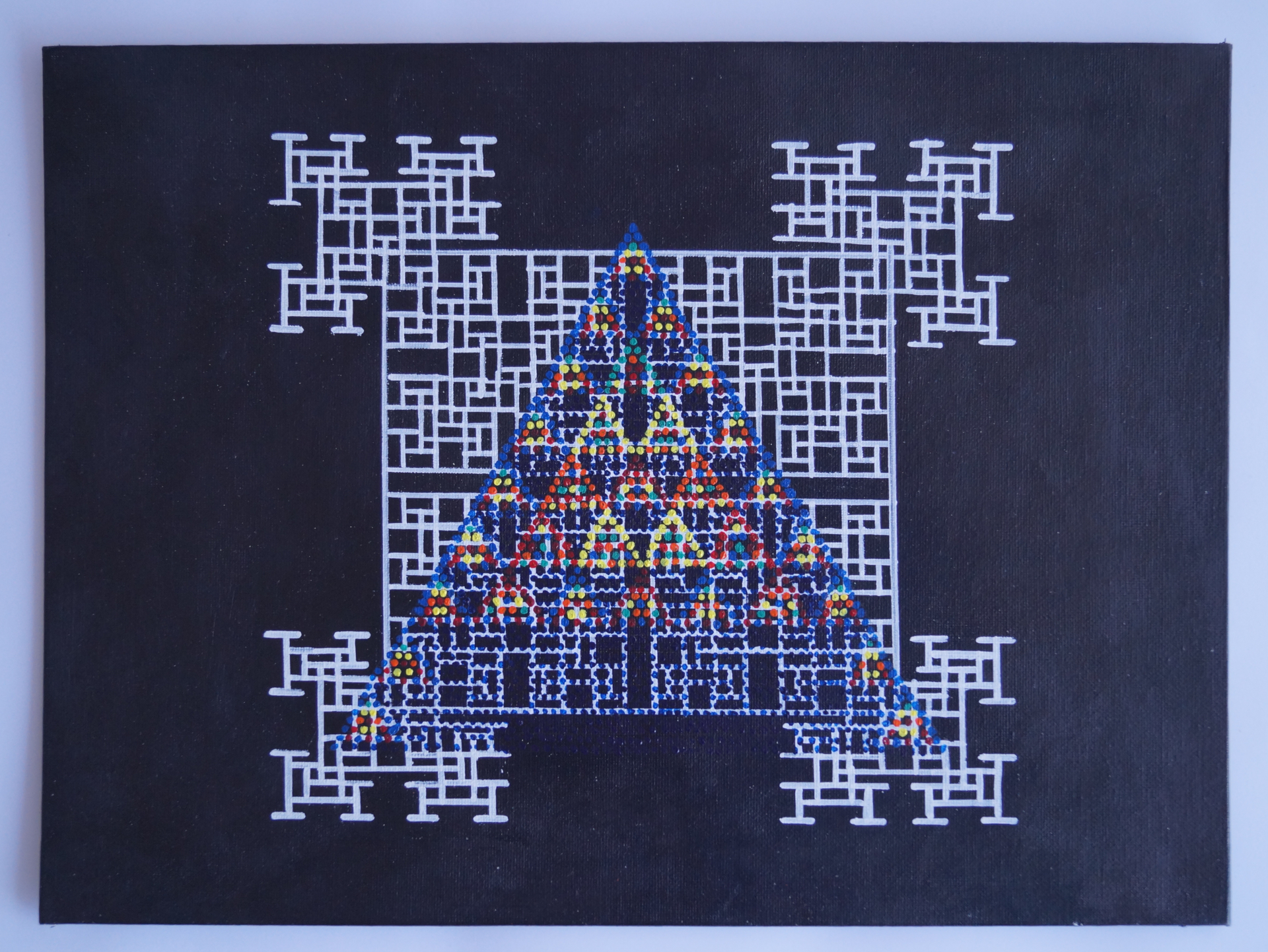
A black canvas with a white toothpick sequence as well as a colored version of the Sierpinski triangle.
On the picture you can see a toothpick sequence in the background, on it lies the Pascal's triangle modulo 7. The pattern of the background is generated by drawing a single stroke of arbitrary length. At the ends of this stroke lines of the same length are drawn perpendicularly to the ends of this line. At the ends of these strokes again of the same length are drawn vertically. The whole thing can be continued as far as you like. Here, this process is repeated 45 times, resulting in 995 strokes. Thereby one can recognize that always at 2n iterations two long, continuous strokes are drawn and at each of the four ends a "new sequence" begins. The name Toothpick-Sequence indicates that this is a sequence and not a fractal. But it looks very similar to a fractal. The sequence is white on a black background. The triangle in the foreground is based on the Pascal triangle, whose numbers x was considered modulo 7. If x mod 7 ≡ 0, then the number was given the color dark blue. If x mod 7 ≡ 1 with light blue, x mod 7 ≡ 2 with green, x mod 7 ≡ 3 with yellow, x mod 7 ≡ 4 with orange, x mod 7 ≡ 5 with red, x mod 7 ≡ 6 with dark red. This creates the fractal that can be seen. It is shown after the 64th iteration and consists of exactly 2080 single color points, whose color was chosen to create a contrast to the black and white background and still keep the simple character.

Cubus Artis

Leo Sprengard

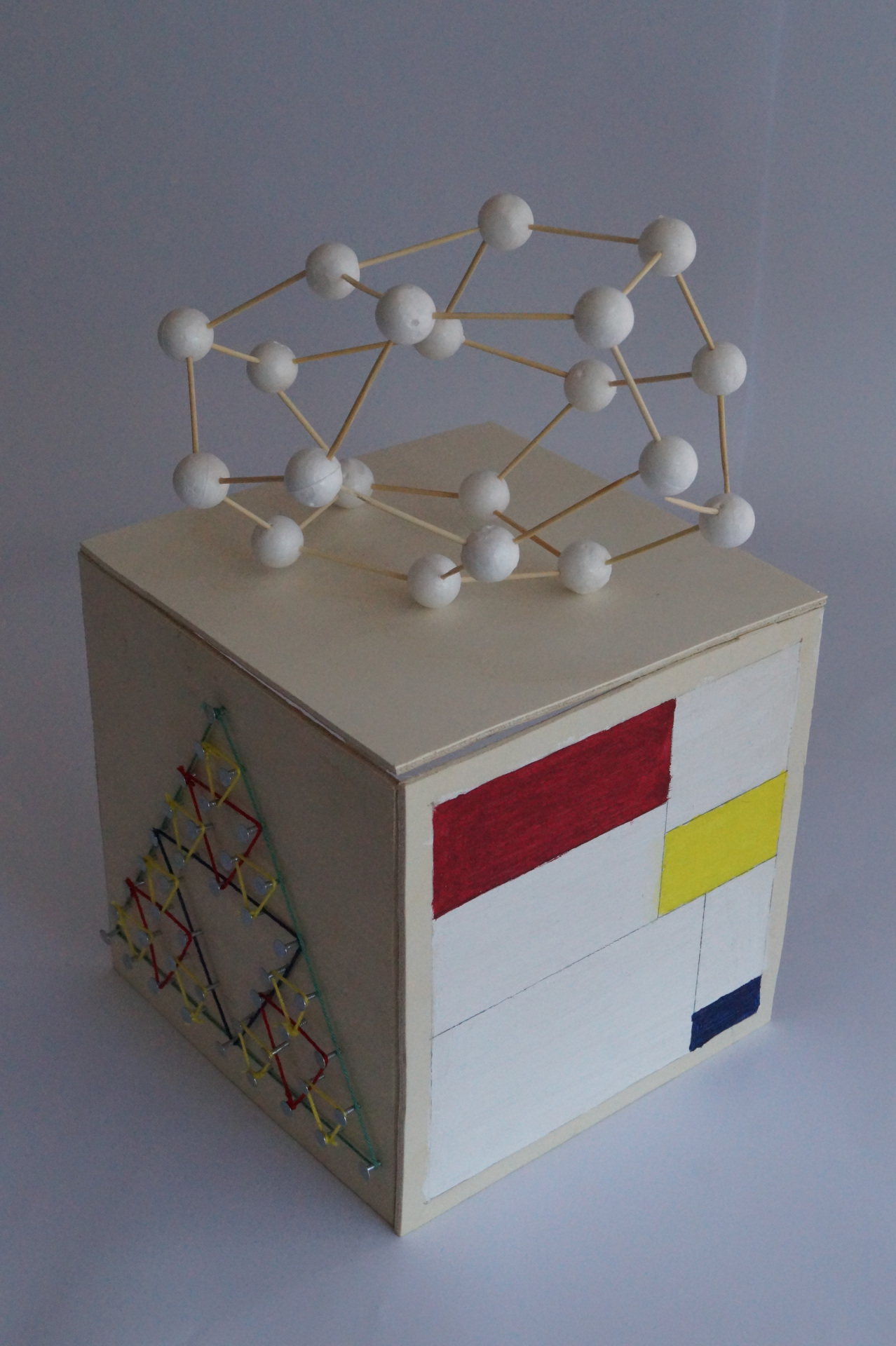
A cube made from plywood. On the left side, a string art Sierpinski triangle is shown. On the right side, a stylized image reminiscent of the work of Piet Mondrian is painted. On top of the cube rests a graph structure made of styrofoam balls, connected via toothpicks.
Cubus Artis is a cube on which on five of the six sides are various works of art with mathematical reference. The cube is built entirely of wood, with an edge length of 20 cm. On the side seen in the front is the Sierpinski triangle. It was implemented using nails to represent its points. On the next page clockwise is a model of the Peterson graph. On the adjacent page is the Pythagorean tree. The last side is covered by a two-dimensional k-d tree, aiming for the best possible approximation to the abstract art of Piet Mondrian (1872-1944) through the characteristic coloring of the rectangles in the three primary colors. On the upper side of the cube is a model of a dodecahedron, one of the Platonic solids. This was built from toothpicks and Styrofoam balls, being stabilized by some thin threads that are not visible. All of the motifs depicted on the sides of the cube are mathematically related. The Cubus Artis serves primarily to present the course content of Course 2.1 Of Bridges, Paths, and Knots as compactly and aesthetically as possible. The viewer thus gains a rudimentary insight into the connection between mathematics and art.

Ungewissheit (Uncertainty)

Mareike Pfeilsticker
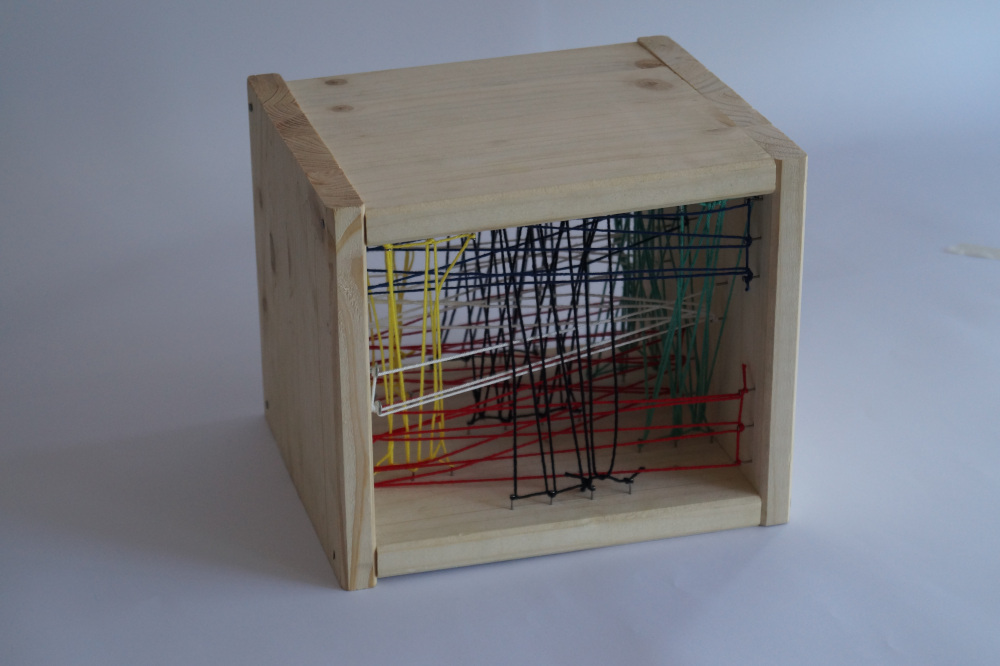
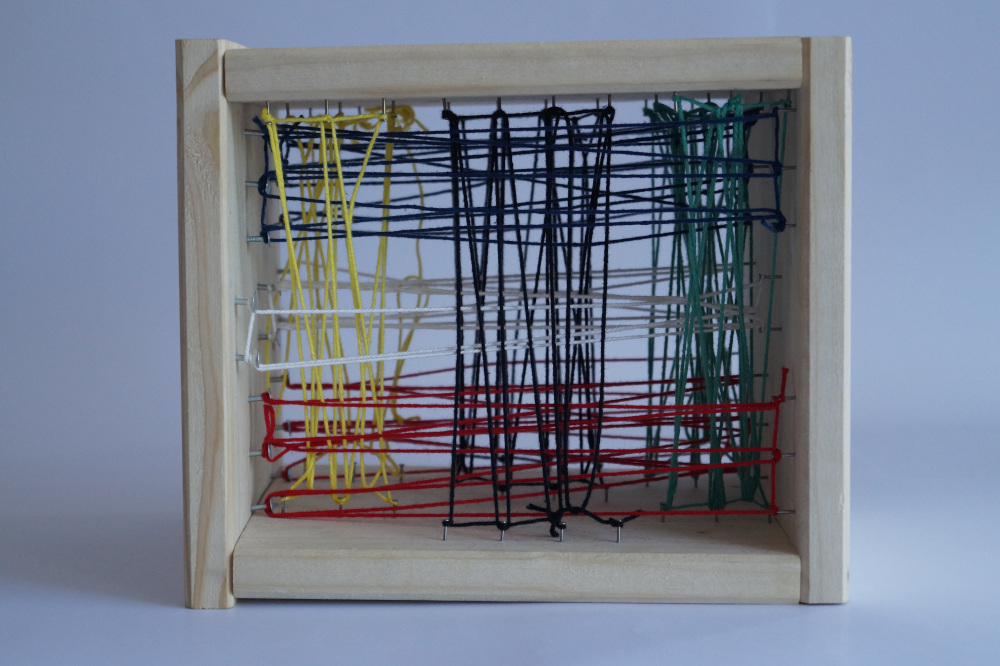
A wooden cube with the front and back missing. Inside is a series of strings that either alternate from the top to the bottom plate or from the left to the right plate. Each series has its own distinct color.
The idea behind my project was to take the graphs that we had been looking at almost exclusively in two dimensions the previous week and represent them in three dimensions. I liked to combine this with string art, in which images are created by hammering nails into boards and then artfully connecting them with threads. Bipartite graphs seemed particularly suitable for this, as they have a simple and ordered structure (when represented appropriately) that can be easily transferred to a higher dimension. However, this simplicity was also a factor that could have easily made the project boring. Therefore, instead of one graph that moved back and forth, I decided to construct six connected graphs that, while all of the same structure, crossed or ran against each other. To do this, I first had to nail four boards with the appropriate nails that would later become the vertices of the graph. Then, I nailed the first three boards together to get two opposite sides already and to span my first three graphs there. For construction reasons, the bipartite property of the graphs could not be preserved, but the basic idea remained the same. After that was done, I also added the fourth board and completed my cube-like construct. The most difficult part followed now, because the last three graphs had to be stretched and I was limited in my freedom of movement by the four boards and the already existing threads. Therefore I took a needle to help. After some mistakes, a little trial and error and many sleepless hours, my project was ready in time for the exhibition on the last academy day.

Baum aus Holz (Tree made of Wood)

Vesselin Matthiesen
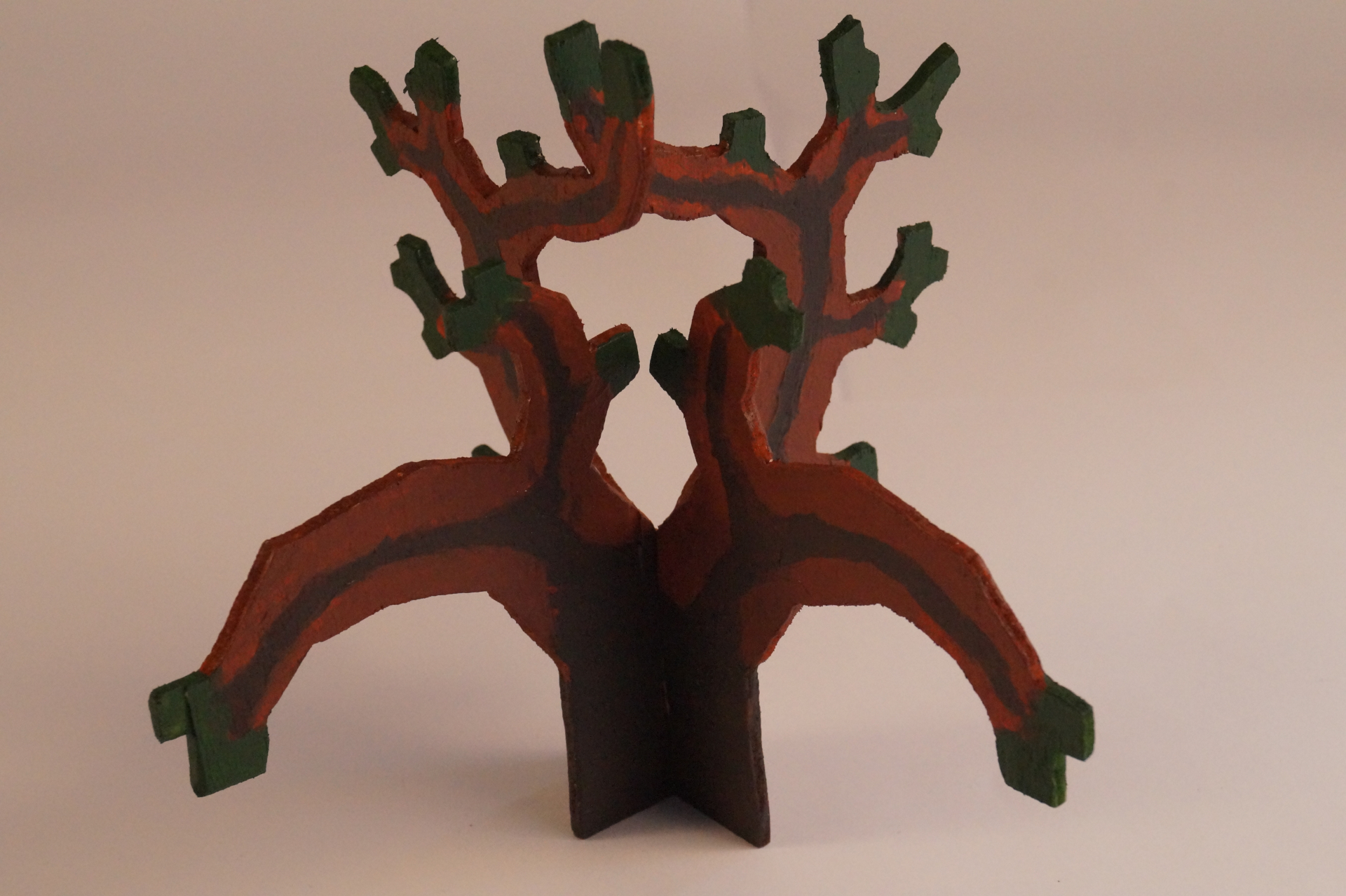
Two colored pieces of plywood, each showing a cut-out of a Pythagoras' tree. They are stuck together at a 90-degree angle to form a 3D tree.
During the course, I was particularly fascinated by the trees of Pythagoras. Here, elementary fractals create very handsome images that can be creatively elaborated on in a variety of ways. My tree is titled "Tree of Wood". First, I drew on a Pythagorean tree at will, then transferred it twice to wood, sawed it out, and put the two two-dimensional trees together at right angles to create a three-dimensional figure. This tree measures measures 20 cm in width and length and 17 cm in height.

Gefangen in Angst und Einsamkeit (Caught in fear and loneliness)

Ira Hesse
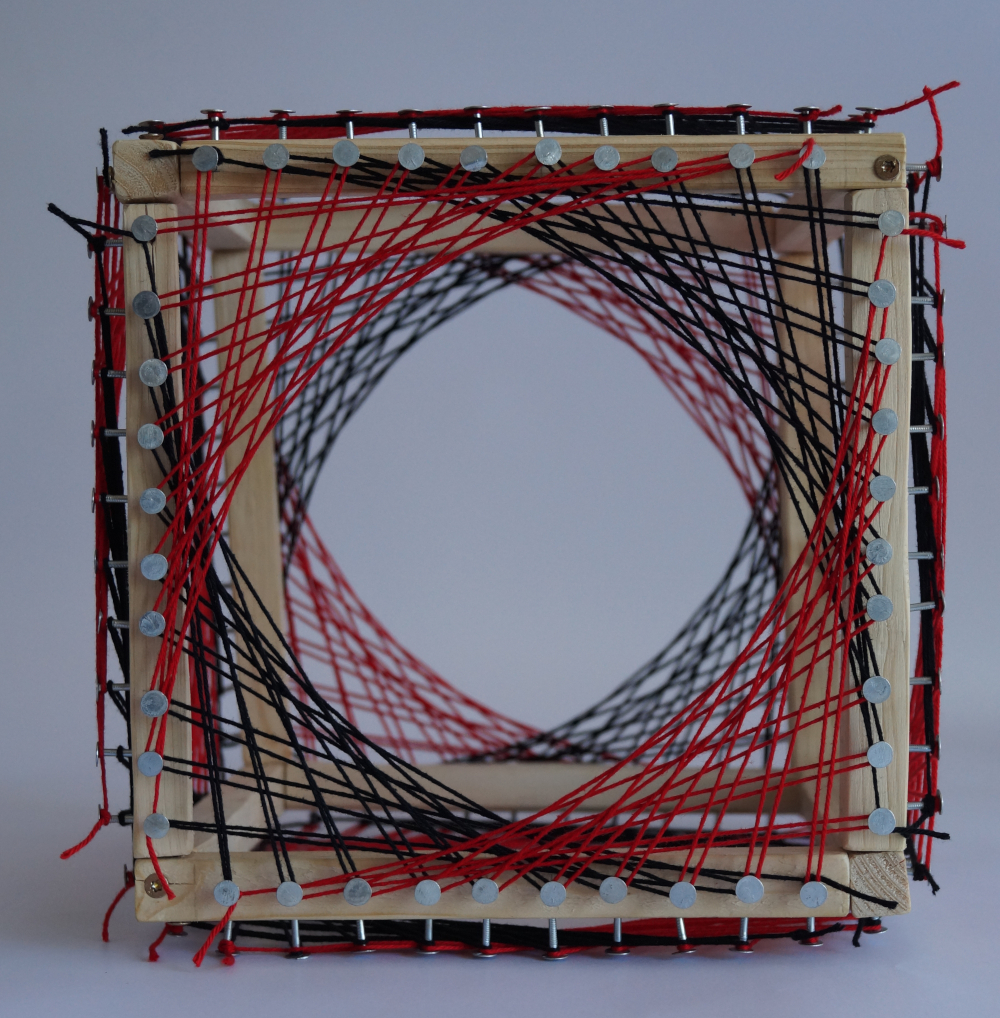
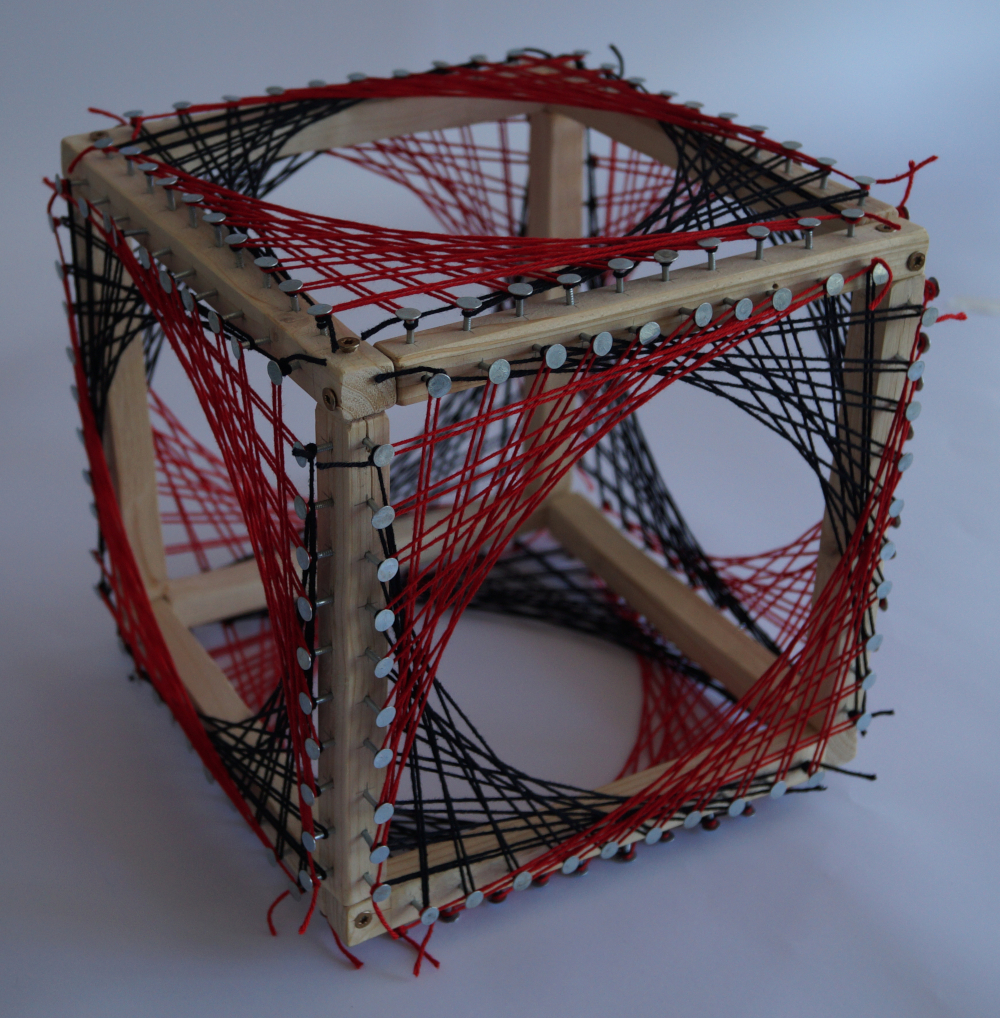
A cube made from wood, with hollow sides. Along the edges of the cube, nails are added. These are connected across the faces of the cube by strings.

In the second half of the course I worked on my art project. After the process of brainstorming with the help of a poster, I decided to create something three-dimensional with string art. In the first step, I made several sketches and visualized my idea using the visualization program GeoGebra5. Planning as accurately as possible went on in measuring the pieces of wood, which I then cut out using a jigsaw and subsequently sanded with a file to make the individual pieces of wood more pliable. After that, I hammered a total of 20 nails into each piece of wood, equally spaced on two sides of the surface. After completing this step, the total of twelve edges were screwed together to form the platonic body of a hexahedron after predrilling.

The last step consisted of stretching four cotton threads – two each in black and red - around the nails for each side surface to create a pattern. In terms of graph theory, we can say that each nail represents a corner and the taut threads represent edges between those, with each individual thread representing a connected, bipartite graph. Altogether, this creates a net that stretches around the cube, appropriating and constricting it. The colors red and black provide a strong contrast to each other and make the object appear rather somber. This supports the effect of being of being trapped and evokes an uneasy tension.


3BiT – Baumspirale (3BiT – Treespiral)

Nolan Emilio Muniz Fernandez
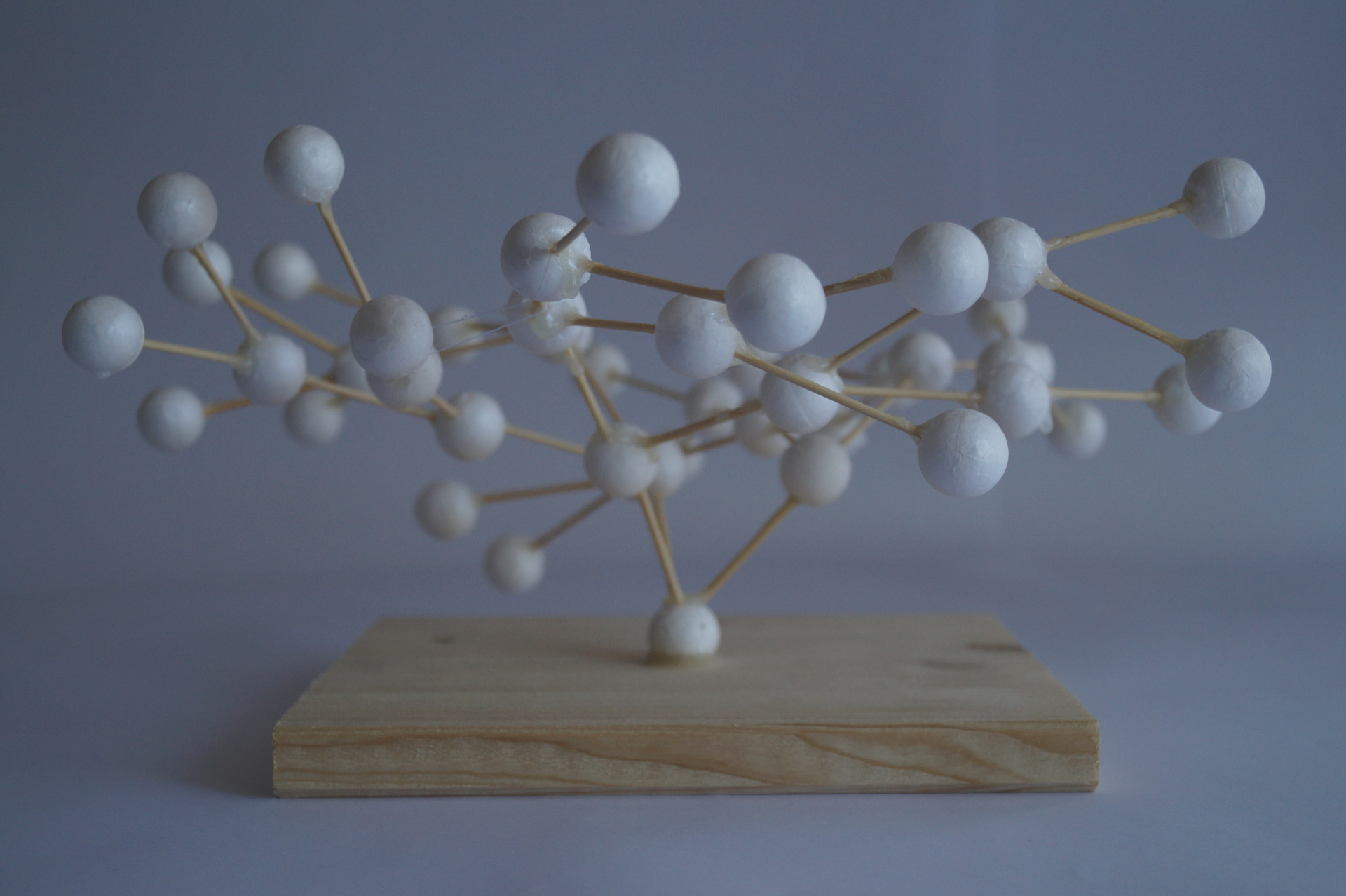
A tree made from styrofoam balls, connected with toothpicks and held in place by thin coards on a base of wood.

How can a tree look like a spiral in 3 dimensions? This is the question I wanted to find out with my project based on an example. However, the project should look realistic, which is why I tried to imitate a tornado or a water vortex.

In the end, I decided not to program my project, but to build it. For this, I used Styrofoam balls and toothpicks, which I mounted on a wooden base. In addition, I used thread to stabilize the tree and maintain the spiral shape until I had completed all the connections between the toothpicks and the balls. I was able to fix all connections between toothpicks and balls with hot glue. The dimensions are 16 cm × 38 cm × 31 cm.

However, I had the problem that my tree spiral in the upper levels very quickly thinned out and lost density. This is where the meaning of "3BiT" comes into play. Since the density was too low, I decided to merge several binary trees at a root and so I got my 3 binary trees in a tertiary tree – tree spiral. obtained.

Overall, my project really resembles a vortex when completed. Similarities I see I see more in a tornado, because it is bigger and more irregular and fits more to the rough structure of my project. In contrast, a whirlpool is very regular and too uniform to resemble my 3BiT – tree spiral.


Stella botanica residua

Tim A. Burdack
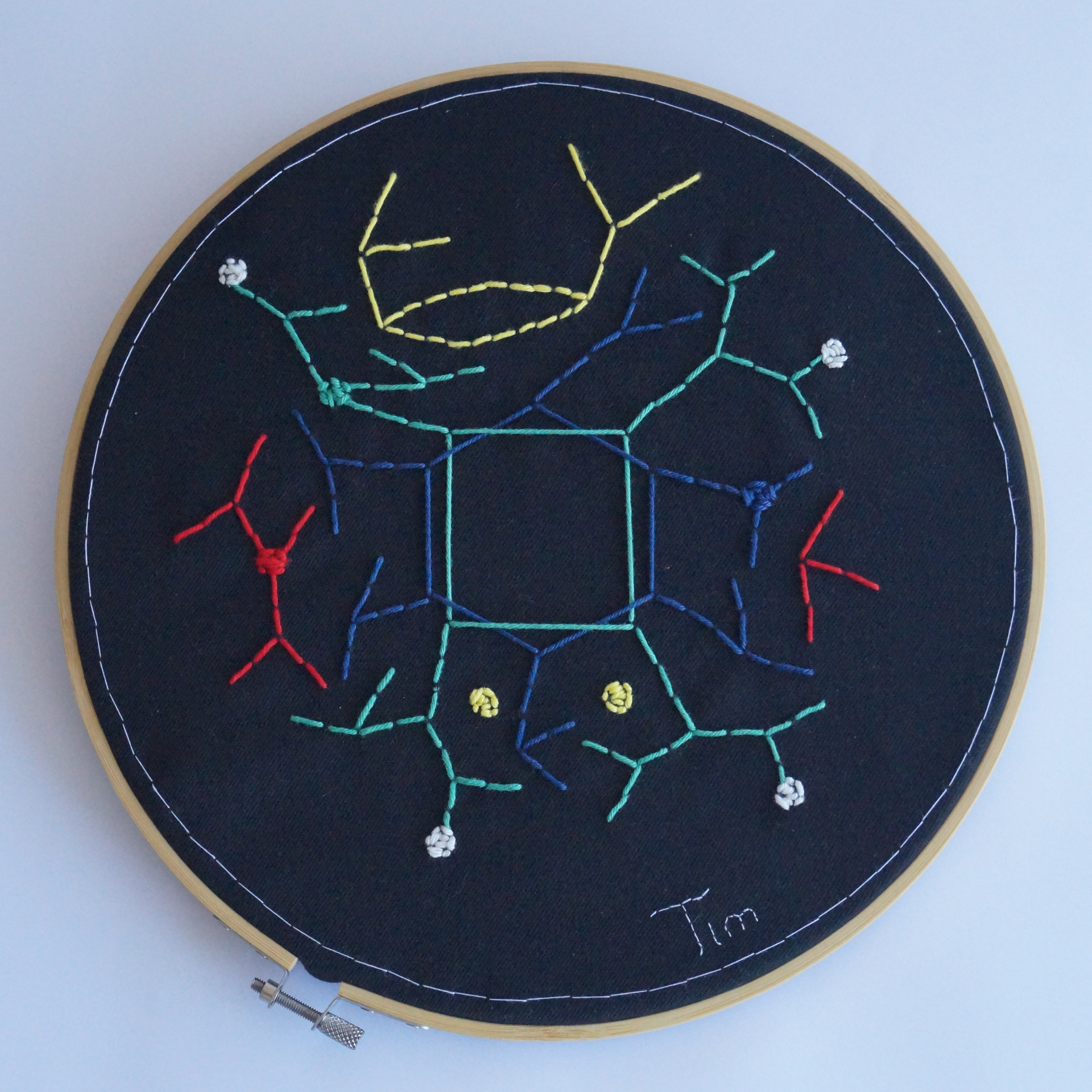
A circular piece of black cloth embroidered with constellation-like structures derived from number theory.

An approach that produces graphs whose structure is backed by a certain pattern and which lend themselves to artistic representation has its origins in number theory. In previous work, graphs of the following form are treated: For n∈N let Dn:=(Vn, En) be the directed graph with vertex set Vn:={0, 1, ..., n-1} and for x,y∈Vn let (x,y)∈En hold exactly if y≡x2 (mod n). For the concrete implementation, I chose particular moduli n, for which I consider the corresponding graphs Dn, whose components and vertices are interlockingly combined and arranged in such a way that an artistic representation of the graphs results. In the practical execution, these graphs are then embroidered with colored threads on a black cloth. For example, different colors can be chosen for different modules or components, or certain corners of the graphs can be highlighted by representing them as circles of different sizes.

I chose the prime numbers 37 and 41 as moduli. The corresponding graphs have four and three components, respectively. The cycles of the largest components, a hexagon and a quadrilateral, are to form the center of the work. The remaining corners and edges of these components shall surround the remaining components, which are placed at the edges of the work. This is to result in a plant-like structure, with flowers representing the outer components.

The completed artwork, shall be titled "Stella botanica residua", because when looking at the work, the individual components of the graphs may also seem like constellations (lat. stella). The remaining components of the title result from the structure of a plant (botanica) and the number-theoretical background (residua).


Strobo Mandalas

Jana Reich
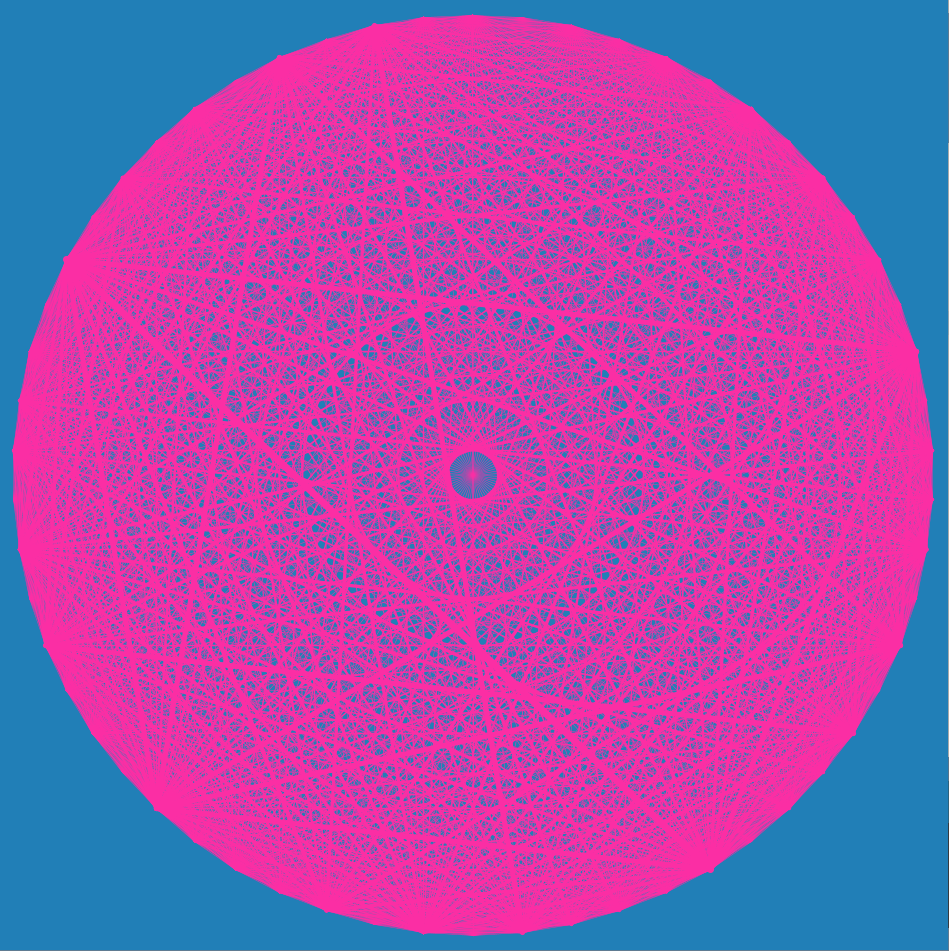
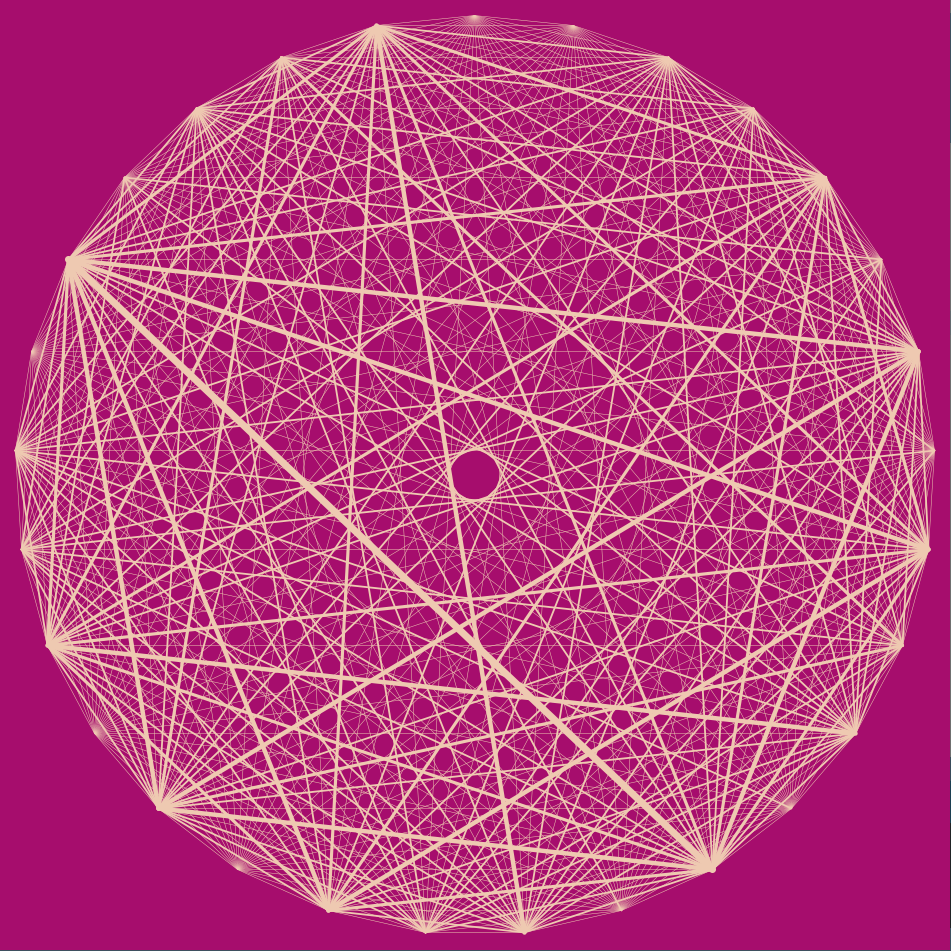
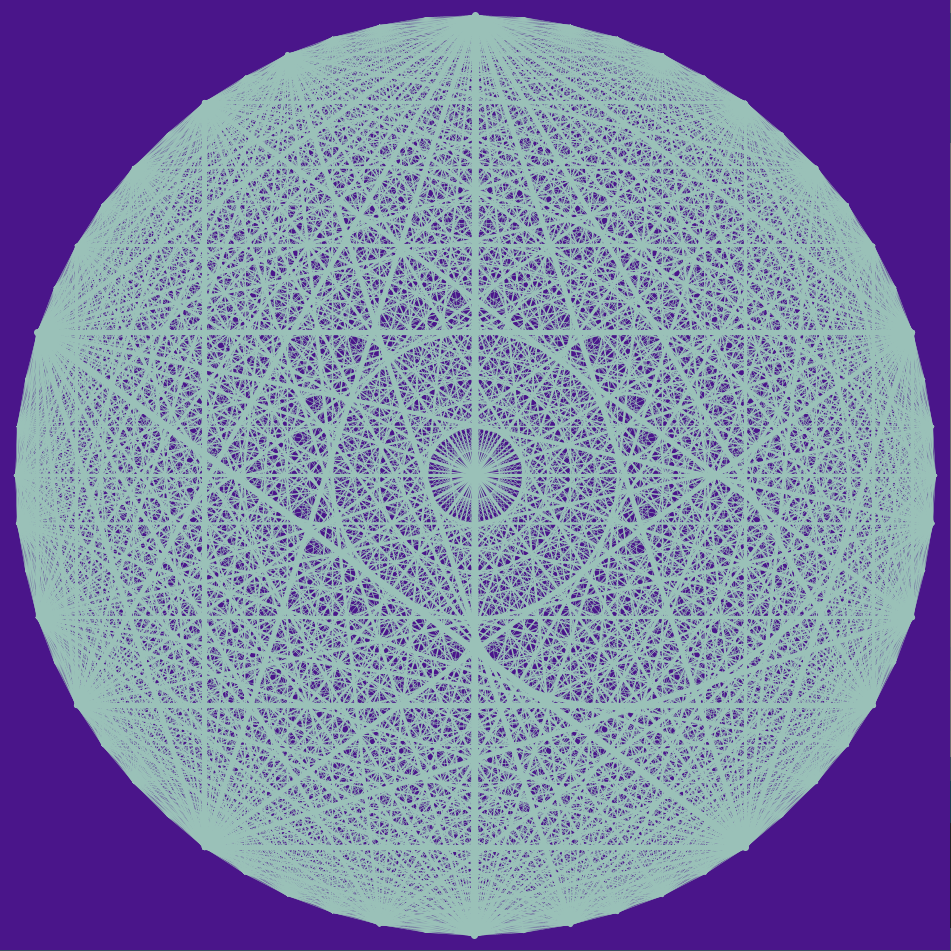
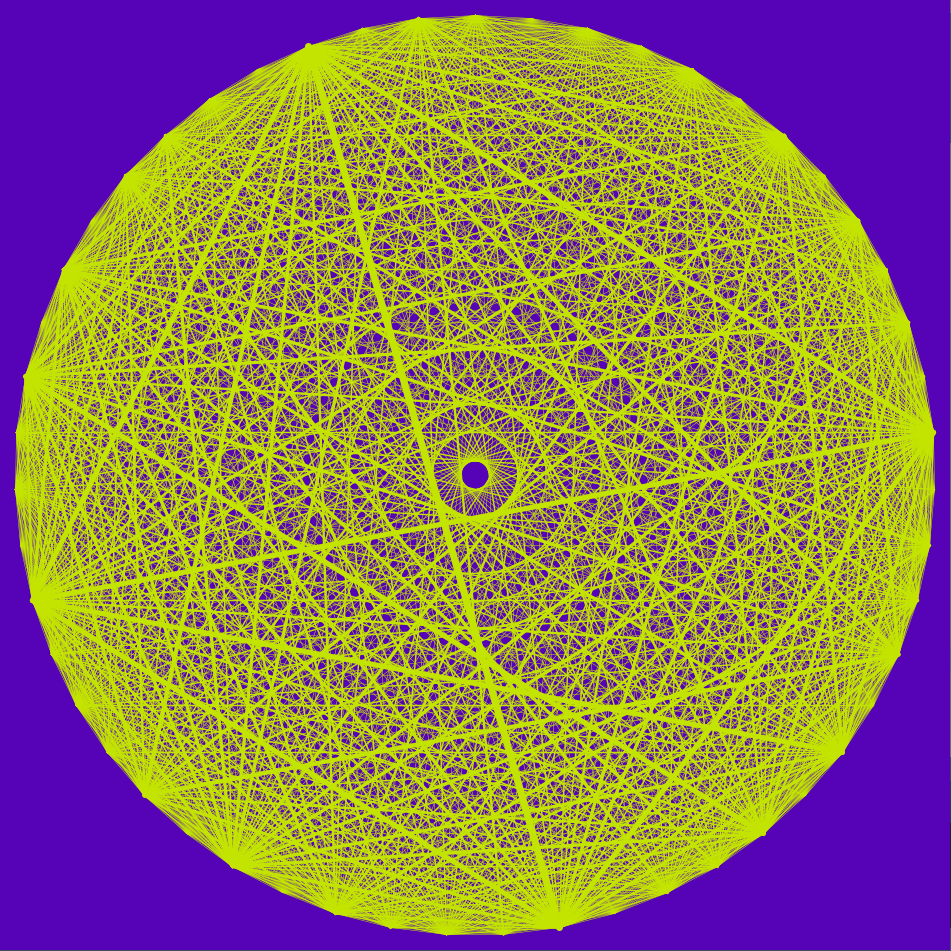
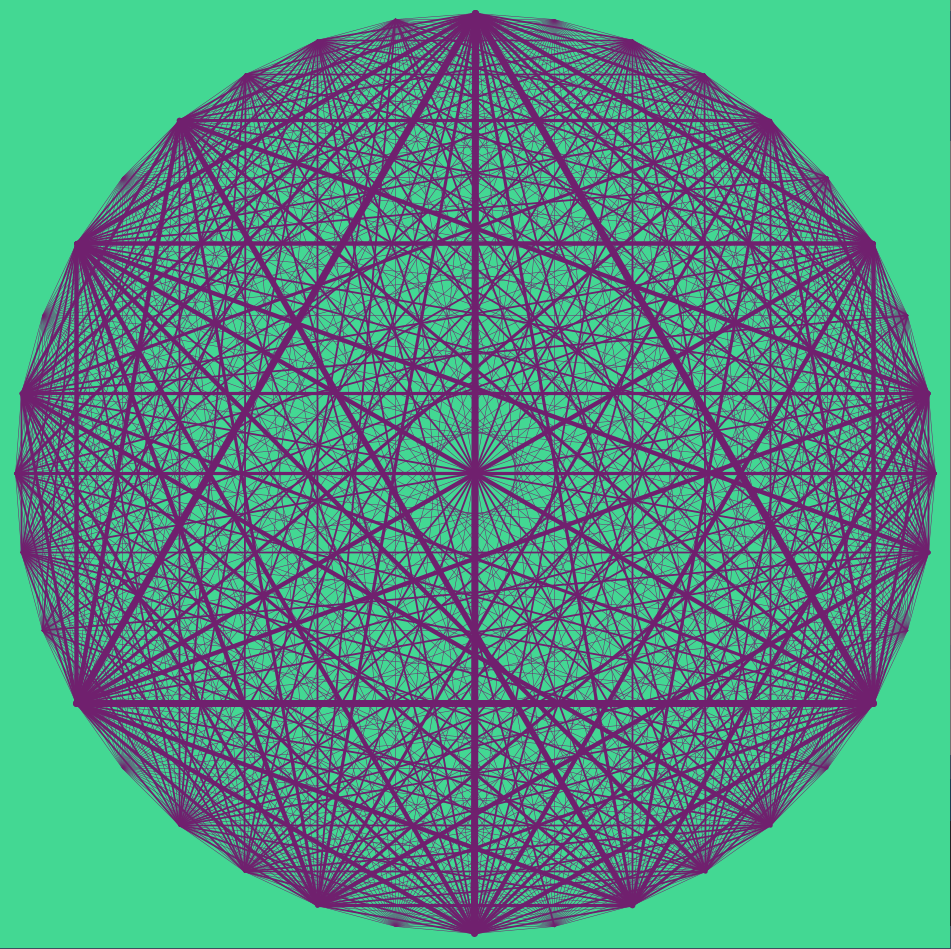
An almost complete graph of several vertices with bright, uniform colored edges on a bright colored background.
The art project “Strobo Mandalas” is a program in Processing which, with the help of loops, constantly plots new complete graphs with random numbers of vertices between 25 and 65. Furthermore, the color of the edges changes randomly with each new graph, analogously the background also changes its color. The time to see a single graph is a few tenths of a second, depending on how long the computer takes to compute. It is precisely these short tions of time make up the stroboscopic effect. The whole thing is completed by short randomly played "plop noises" from the C major scale.

Graf-Schaph (Count of Sheeph)

Jana Reich
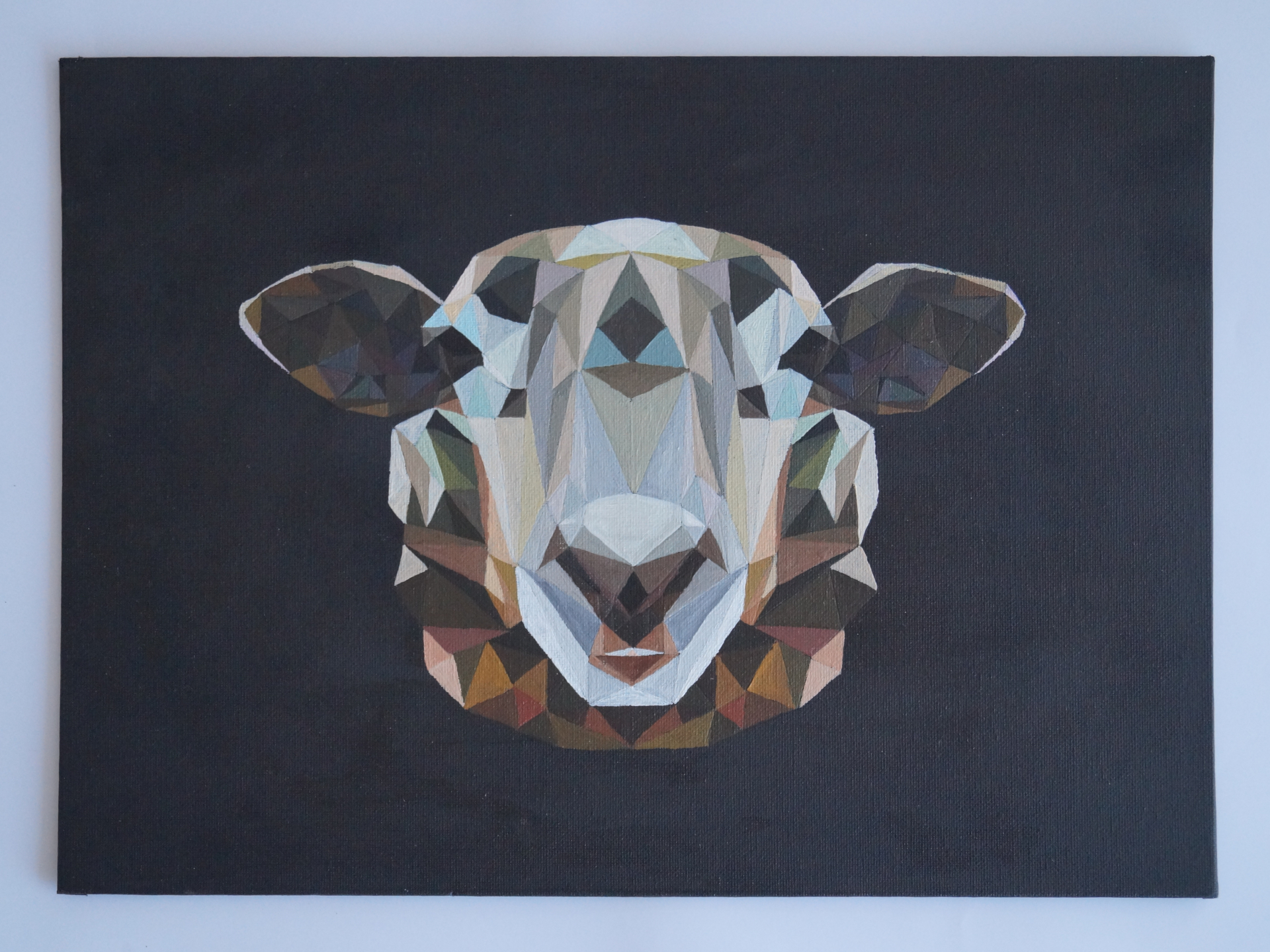
A triangulated sheep, drawn with acrylic paint.
The representation of the “Graf-Schaph” is based on a triangulation of a sheep. This created the image of the sheep as a planar graph. The areas of the graph were colored so that the sheep appears plastic. This is precisely why some adjacent triangles have the same color and other polygons are created that are not triangles. The main inspiration for this project came from the rhyme of the words “Graph” and “Schaf” (sheep).

Dreierlei Ecken (Three kinds of corners)

Paul Kästner
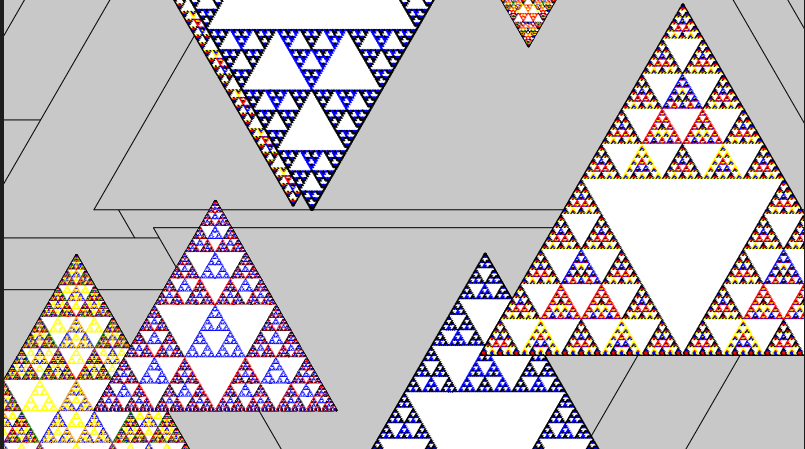
A set of several Sierpinski triangles, lying on top of each other and a background made from gray triangles.
I was particularly captivated by the Sierpinski triangles, so I decided to make them the central theme of my artwork. Unfortunately, these are only black and white, which is due to the fact that they are formed as Pascal triangles modulo 2. However, it is also possible to increase this modulo number, as I did, for example, up to 9, to create more colorful triangles. Now, I have created some of these different triangles with random size, modulo number and position, and generated them on the canvas.

Distanzmatrizen von Tertiärbäumen (Distance matrices of terniary trees)

Helen Anderl
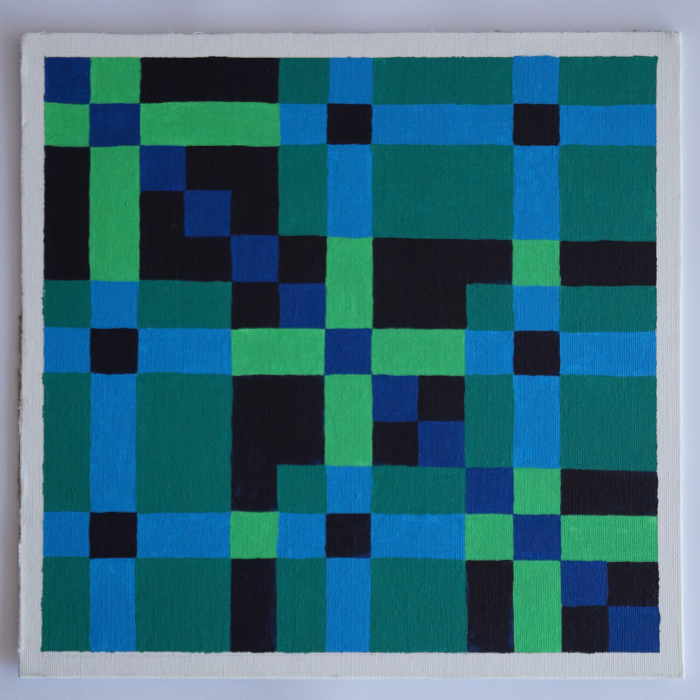
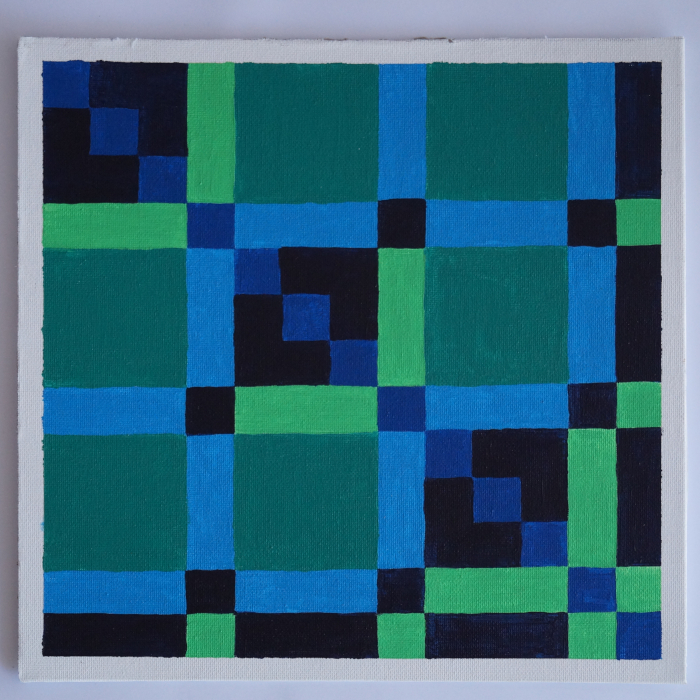
An illustration of a graph's distance matrix, drawn with acrylic paint. Each cell of the matrix has its own color, chosen depending on the cell's value.
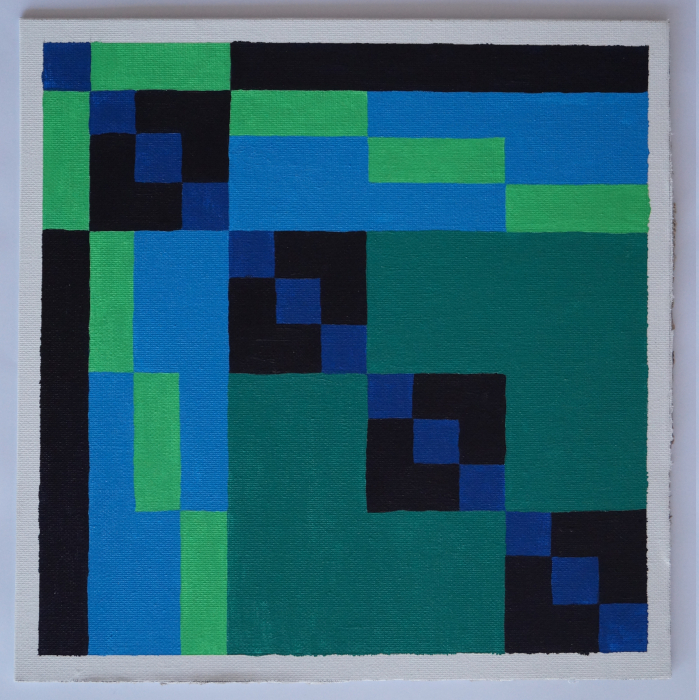
When we dealt with graph theory in the first part of the course, one of the topics discussed was distance matrices of different graphs, which I found very interesting. Therefore, my art project is based on distance matrices of tertiary trees. In my project, the distances of the 13 corners of tertiary trees were determined and then each was colored with different colors. Since there are different ways to number the corners of the trees, this resulted in several different distance matrices. I implemented the project artistically by transferring the (distance) matrices onto painting boards using acrylic paints in five different shades of blue and green. This resulted in three works as a triptych.

Don’t PRESS the button

Sophie Pahmeyer
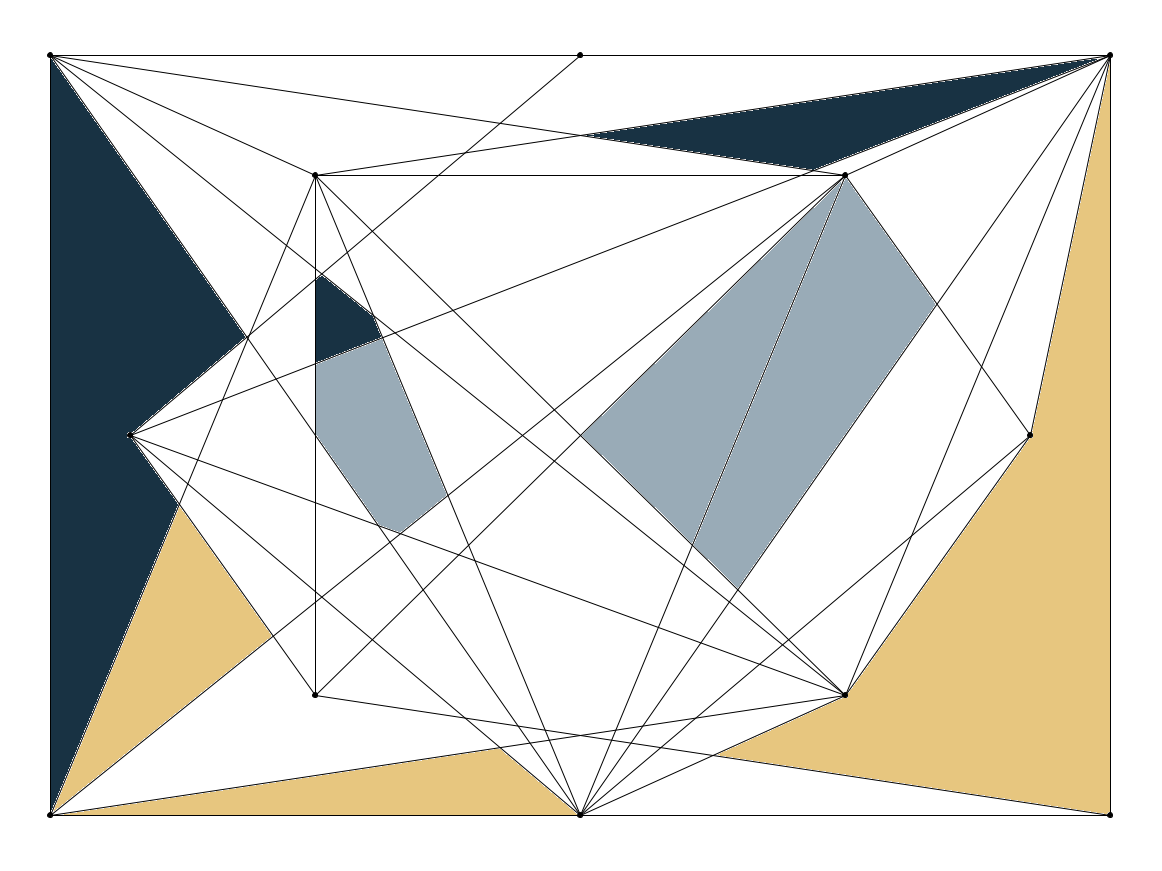
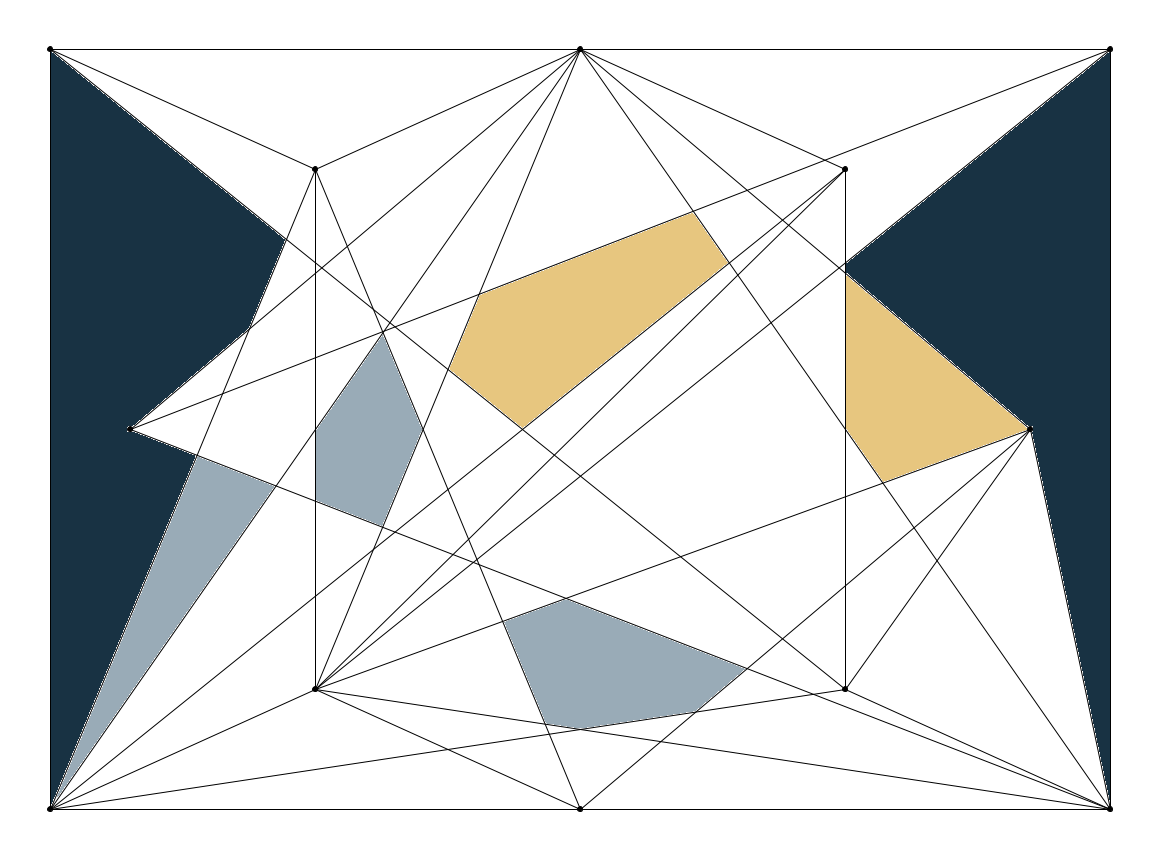
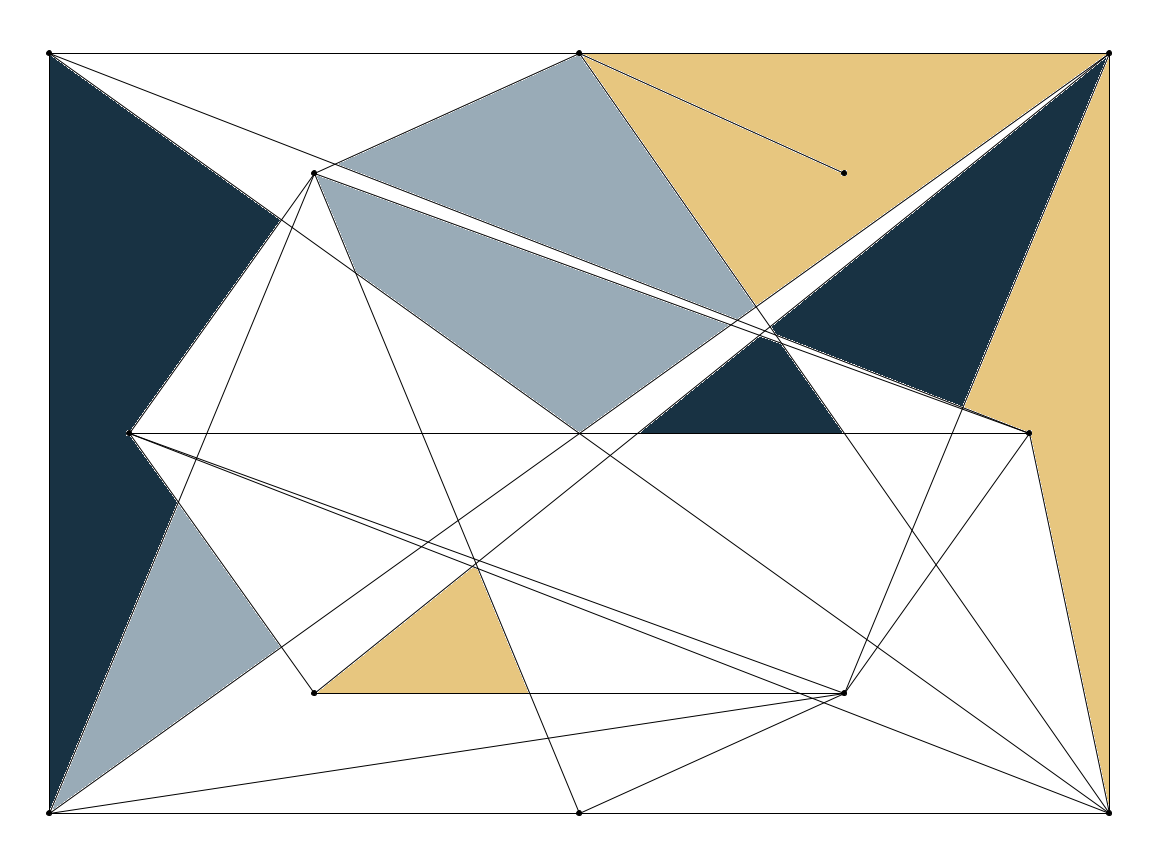
A rectangle with a total of up to twelve vertices that are randomly connected by edges. The resulting polygons are randomly colored.
“Don't PRESS the button” is an interactive artwork that plays with humanity's desire to do something forbidden in order to make them press the button. The more you press the button, the more you can see the structures of the work. Behind “Don't PRESS the button” lies an algorithm that begins by constructing a complete graph K12 of twelve fixed vertices on a window of 1200 × 900 pixels. Then, all interior edges are deleted with a probability of 40% each, resulting in a mosaic pattern of 2-dimensional polygons. The algorithm then looks for nine random pixels within the outer edges and colors each three pixels in one of the three fixed colors golden yellow, light blue or dark blue. The pixels now look at their neighbors and color them as well if they are white. Thus the color spreads to the black edges and 1 - 9 polytopes are colored. If you press the button, the algorithm repeats and a new artwork is created, which is similar to the previous one both in structure and colors, but still has its own unique aesthetics. The colors consist of an average of 2/3 shades of blue, which are symbolic of the mathematics behind the work. While the lighter blue, along with the white areas, is intended to create a bright, friendly aesthetic, the harmony of the darker blue and the contrasting golden yellow elevates the work to a more noble dimension. In particular, this creates a perfect balance of chaos, order and harmony on each artwork.

Grundfarben Pythagorasbaum (Primary color Pythagoras' tree)

Emilia Nebel
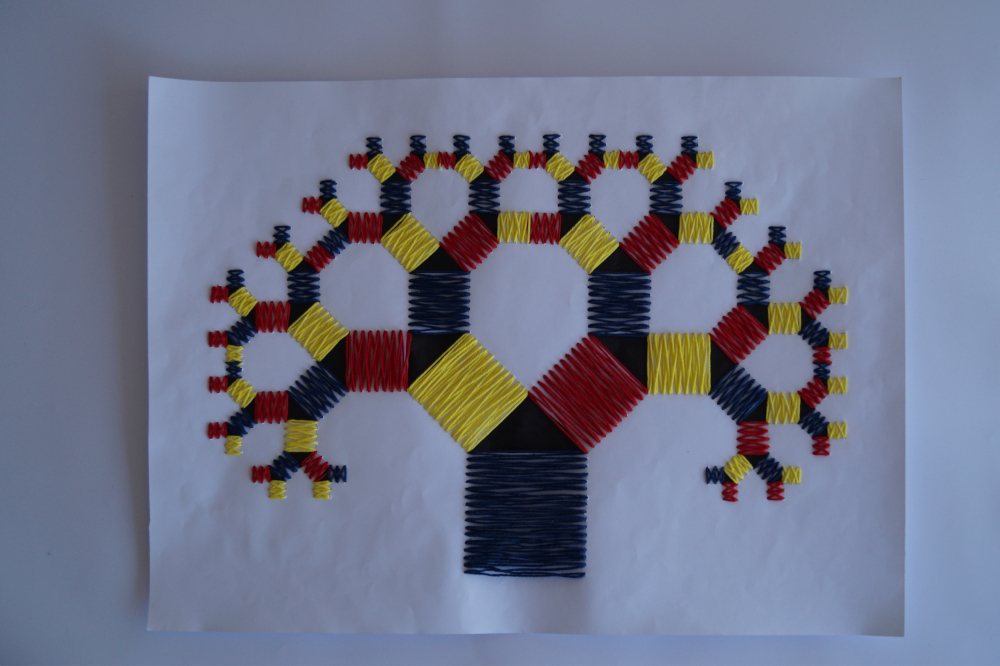
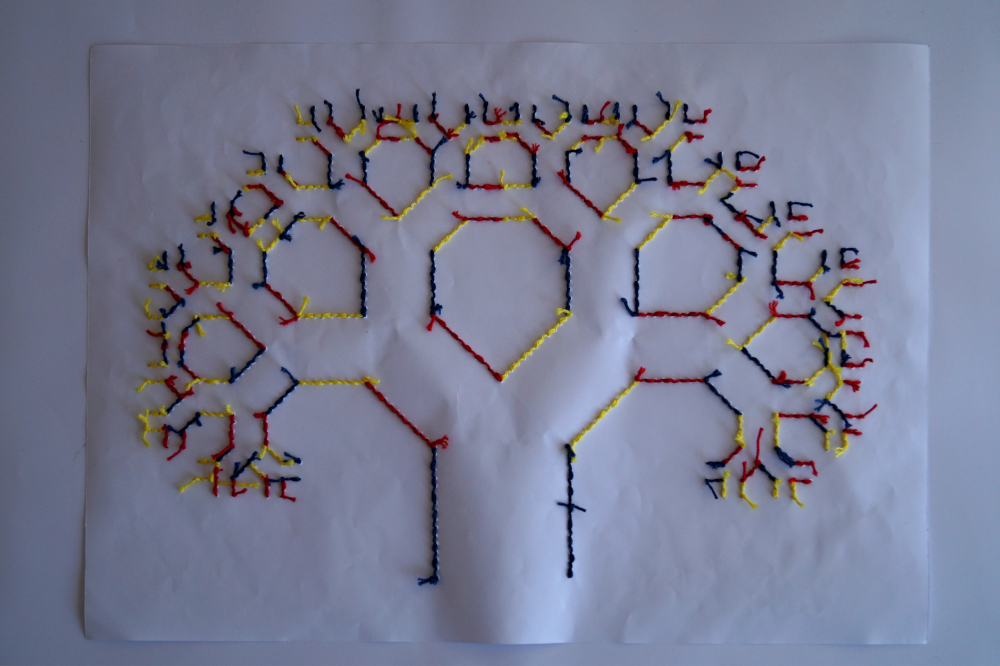
A piece of paper with a tree of Pythagoras. The squares are stitched with yellow, blue, or red thread respectively. The triangles are colored black.
The backside of the piece of paper, here, because of the stitching, only the outline of the tree is visible.

The basic concept of my project is based on a Pythagorean tree, which is an artistic elaboration of a binary tree. The tree I chose has six iterations, since the tree structure only then becomes really clear, see Figure 1.34. The triangles I used are equilateral, so that the tree is symmetrical. The squares are colored in the primary colors blue, yellow and red, whose arrangement around the triangles is reminiscent of a color circle in color theory. If you walk along any of the black colored triangles in one direction in the circle, you will notice that the order of the colors is always the same.

The project was created on a 50 cm × 37 cm drawing cardboard. The triangles are colored with acrylic paint and the squares are stitched with stitches each crossed with cotton, creating a bipartite graph for each square.


The Blue Boat

Luzi Soetje
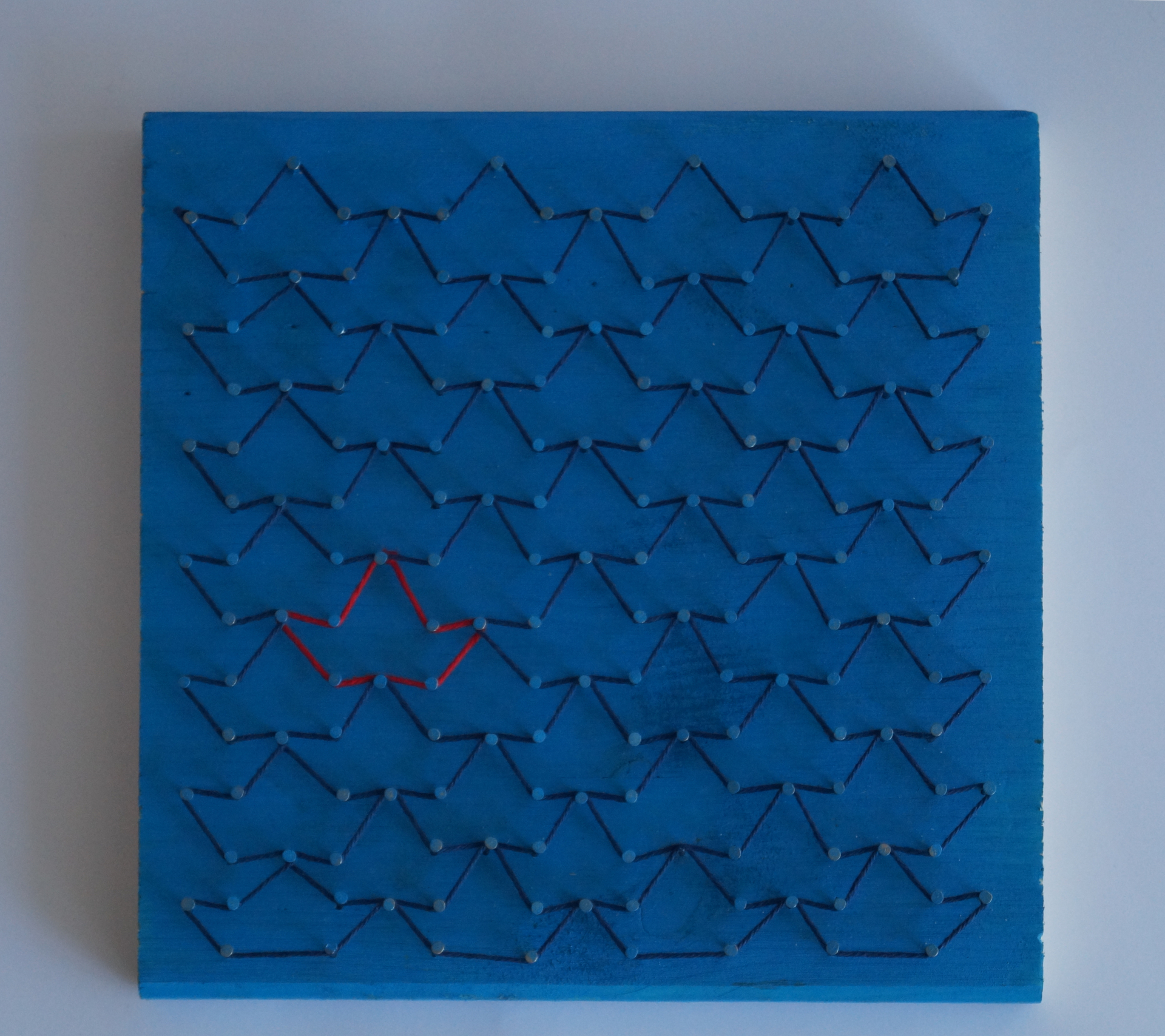
A wooden board painted blue with nails hammered into it that are connected via a dark blue thread. The way the nails are connected reminds of paper boats. One of these is highlighted red.

My project is a nail board that represents a mosaic of structures resembling paper boats. I first painted the board (20 cm × 20 cm × 2 cm) with blue acrylic paint and then hammered the 175 nails into the wood in the desired pattern. Then, I connected the nails with a long blue cotton thread and used a red thread for a single boat.

I chose a blue color for the background to mimic the ocean. The thread is a slightly darker blue, so the boats are visible, but still reminiscent of the ocean. The red thread highlights a boat and not only makes it easier to see the structure, but also draws the attention of those looking at it.

Since my nail board is a Euler circle, I took advantage of this feature: it is possible to use exactly one thread for each color and thus connect all the nails correctly and arrive back at the starting point.


Als der Baum dem Walde entsprang (When the tree sprang from the forest)

Josephine Wehner
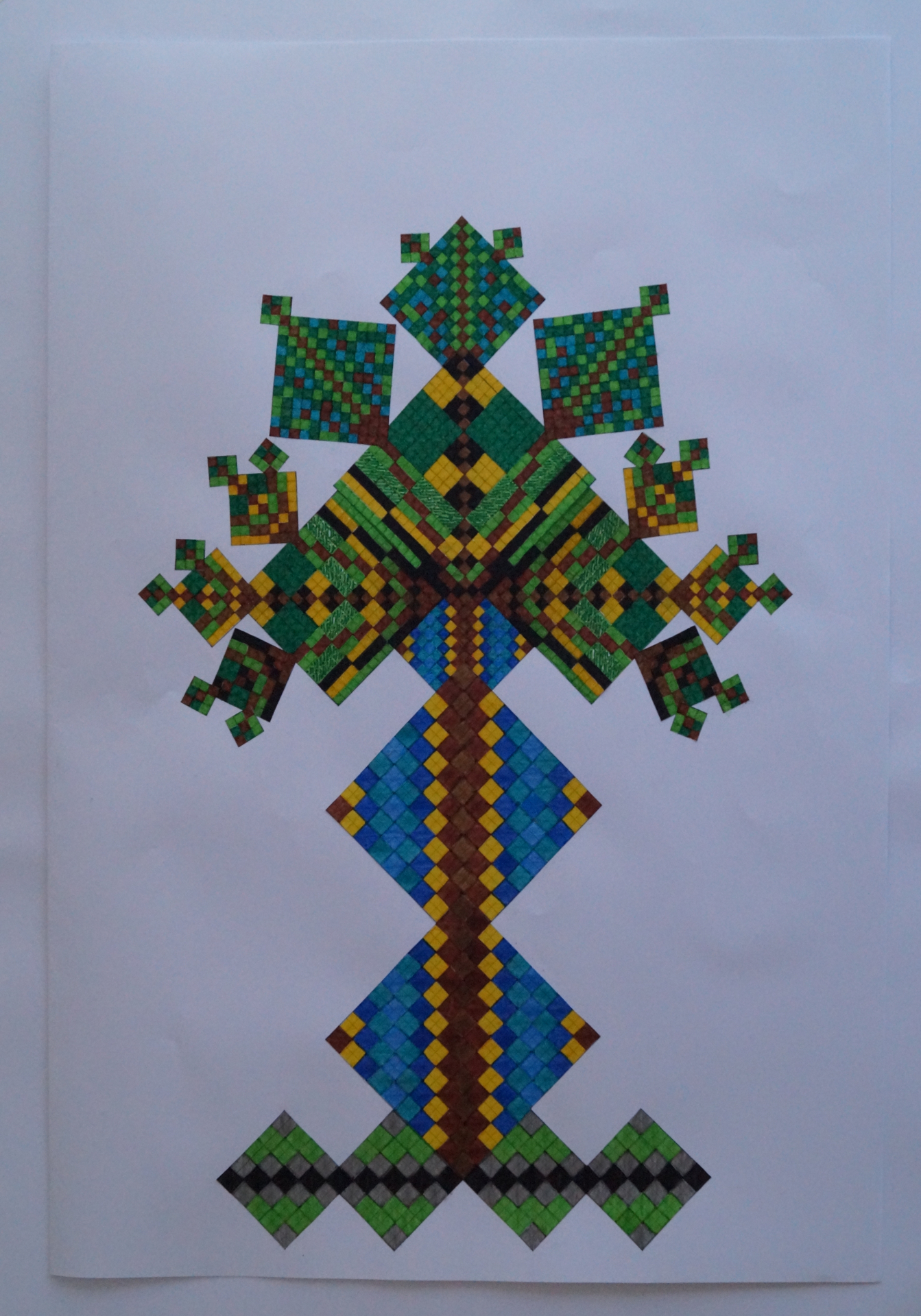
An arrangement of several distance matrices, where each matrix cell is colored according to its respective value. The arrangement forms a tree.
The first rough idea for my art project came to me after I gave my lecture on distance matrices. At the beginning, my plan was to design an image and set up a suitable graph for it. However, I had to realize that this method quickly leads to situations where it is no longer possible to completely match the graph with the planned distance matrix. This makes it difficult to represent more complex motifs in a single distance matrix. When I realized what I just described, I had a new idea. Instead of limiting myself to a single distance matrix, I now wanted to represent a particular motif in several, less complicated, matrices. Since I had already looked at some distance matrices of binary trees for my lecture, I knew about their interesting structures and since I always liked real trees, I decided to make a tree out of the colored distance matrices of some different graphs. For the tree crown I used mainly the graphs of trees and binary trees. Thus, my work is largely made up of other trees, which could be said to make it a tree made up of a forest. It was this consideration that eventually helped me choose a title for my work. Therefore, my art project now bears the name “Als der Baum dem Walde entsprang” (When the tree sprang from the forest).

Ein Baum sagt mehr als tausend Zahlen?! (A tree says more than a thousand numbers?!)

Isabella Kaindl
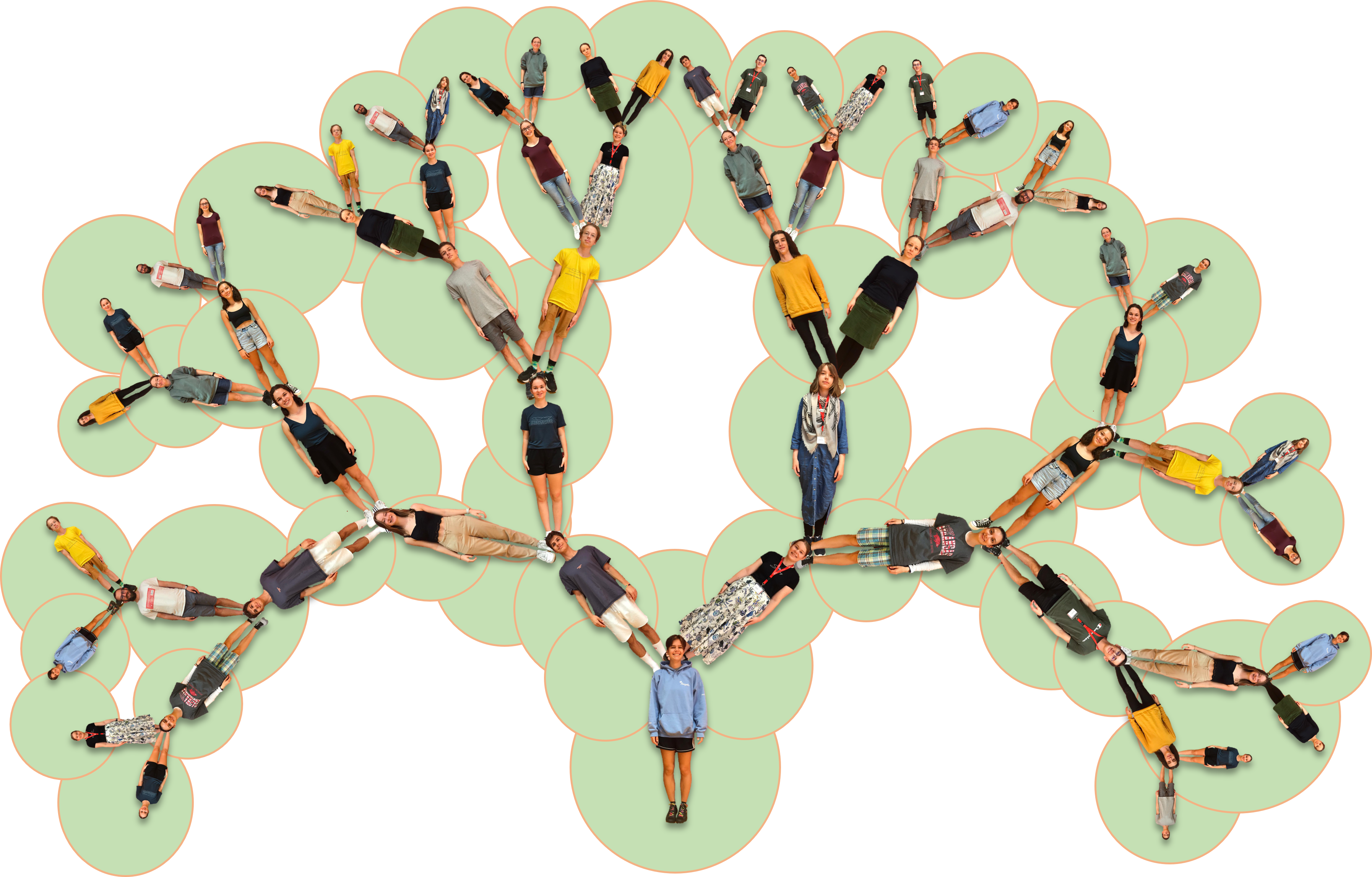
A binary tree whose edges are photos of various people. Around their heads is a green circle in the background, supporting the tree-nature of the artwork.

The correct visualization of graphs often leads to problems, because in most cases this can only be achieved by reducing the information. Especially the representation of higher dimensions quickly shows us our limits. However, visualizations also give us many possibilities. This becomes clear for example in my art project. The 63 edges of the binary tree are not represented by simple lines, but by other course participants. For this, I photographed them, cut them out (digitally), and then arranged them as desired. The individuals, already distinguished by their clothing, thereby build up the intrinsically ordered and symmetrical graph. The possible interpretation ideas of this newly created unit seem almost unlimited.

Subsequently, I have extended the tree with green circles in the background to allude to a tree in a biological sense. This makes it clear even for those who have not yet dealt with graph theory, what is to be represented here. Through illustration, I try to make an insight into graph theory through art accessible to everyone. So although a lot of important information can be lost through visualization, I have tried to create a connecting and interdisciplinary work with art through it.